The Four Horsemen are four conflict habits that psychologist John Gottman's research linked with relationships breaking down: criticism, contempt, defensiveness and stonewalling. Each has an antidote: a gentle start-up for criticism, a culture of appreciation and respect for contempt, taking responsibility for defensiveness, and a break of at least 20 minutes to calm down for stonewalling.
The horsemen are one part of a larger approach. Gottman Method couples therapy starts with an assessment, made up of a joint session, time with each partner on their own and questionnaires, so the therapist can see which of these patterns show up in your arguments, and how quickly, before suggesting what to work on. This article stays with the patterns themselves: what each one sounds like, its antidote, and what the research behind them does and does not show.
What Are the Four Horsemen?
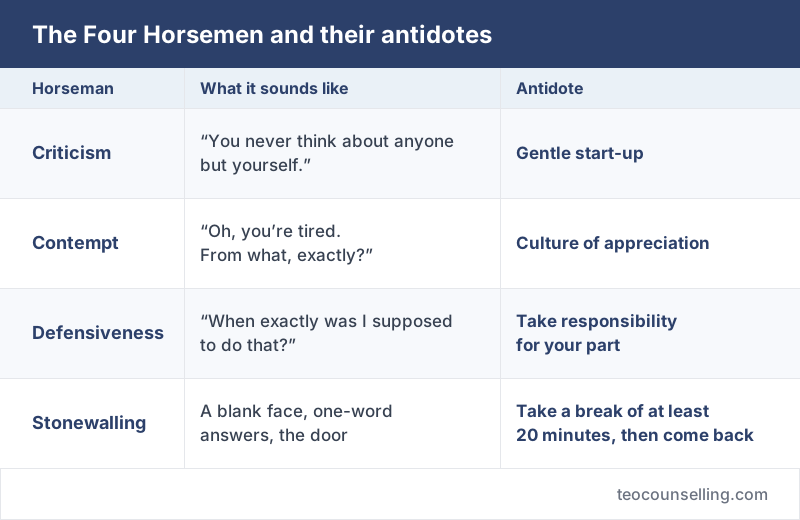
The name borrows the four riders of the Book of Revelation, a picture of patterns that warn of trouble ahead if nothing changes. Any of the four can turn up in a good relationship on a bad day. The concern is when one becomes the usual way a couple argues and nothing repairs the damage afterwards. Here is each one beside its antidote, with everyday examples written for this article:
| Horseman | What it sounds like | Antidote | What the antidote sounds like |
|---|
| Criticism | “You never think about anyone but yourself.” | Gentle start-up | “I was late because the tank was empty. Can we agree whoever takes it below a quarter fills it?” |
| Contempt | “Oh, you’re tired. From what, exactly?” | Culture of appreciation | “Thank you for sorting the school forms last night. I noticed.” |
| Defensiveness | “When exactly was I supposed to do that?” | Take responsibility for your part | “You’re right, I did forget. I was rushing and didn’t write it down.” |
| Stonewalling | A blank face, one-word answers, the door | Take a break of at least 20 minutes, then come back | “I can’t do this well right now. Twenty minutes and I’ll come back.” |
What Is Criticism in a Relationship, and What Is the Antidote?
Criticism is a complaint aimed at a partner’s character rather than at a specific behaviour, and it is the first of the Gottman Four Horsemen. A complaint is about something that was done. Criticism is about the kind of person who did it. The tell is a generalisation — always, never, you’re the kind of person who.
What it sounds like: “You left the car on empty again. You never think about anyone but yourself. That is exactly your problem.”
The first sentence is a complaint and it is legitimate. Everything after it is an argument about character, and character arguments cannot be resolved — there is nothing to negotiate, only something to defend. Criticism can invite the second horseman.
The antidote. Say how it affected you, then say what you want. No diagnosis of the other person: “I was late this morning because the tank was empty and I was stressed the whole drive. Can we agree that whoever takes it below a quarter fills it?” Same complaint, nothing to defend against. One mistake is smuggling the verdict into the second half — “can we agree you’ll stop being so thoughtless about it.” If the sentence still contains a judgement on the person, it is not a start-up.
What Is Contempt in a Relationship, and What Is the Antidote?
Contempt is criticism delivered from a position of superiority, and it is the second of the Gottman Four Horsemen. Sarcasm, mockery, name-calling, mimicry, the eye-roll, the small laugh at the wrong moment. Contempt does not say you did something wrong. It says you are beneath me. That is the line between criticism and contempt: criticism attacks what kind of person your partner is, contempt communicates that they are lesser than you.
Why the Gottmans treat it as the most corrosive of the four. In the Gottmans’ research, contempt was the strongest predictor of separation among these patterns — a finding from the same prediction work discussed below, and debated on the same grounds. Whether or not the statistics hold, the pattern is worth recognising, and the reason is structural. Criticism, defensiveness and stonewalling are poor ways of handling a disagreement, and a disagreement can still be resolved. Contempt is not about the disagreement. It communicates disgust, and disgust is a message about worth, not behaviour. You cannot apologise your way out of being seen as lesser, and the person on the receiving end can stop bringing things up at all — which can mean the actual problems go unspoken and grow.
The antidote. Not compliments to order, which everyone can hear through. It is the deliberate habit of noticing out loud: what your partner did today, what they carried, what you would miss. It changes what you scan for. This is the slowest of the four antidotes and the one with the widest reach. Expect the first attempts to sound stilted. Stilted and said is still better than smooth and unsaid.
What Is Defensiveness, and What Is the Antidote?
Defensiveness is meeting a partner’s complaint with an excuse, a counter-complaint or wounded innocence instead of any acknowledgement of it, and it is the third of the Gottman Four Horsemen. It can be a response to feeling attacked, which is why it can follow criticism so closely. It is also, in effect, a way of saying the problem is not me — which can escalate rather than settle things.
The antidote. Grant the part that is true, even if it is a small part. “You’re right, I did forget. I was rushing and I didn’t write it down.” Accepting some responsibility is not conceding the whole argument. It can be what lets the argument stop being about the argument.
What Is Stonewalling, and What Is the Antidote?
Stonewalling is withdrawing from an interaction with a partner rather than responding to it, and it is the fourth of the Gottman Four Horsemen. A blank face, one-word answers, looking at the phone, leaving the room. It looks like indifference from the outside and can be the opposite from the inside — it can come from the body being overwhelmed, at which point taking anything in becomes genuinely difficult.
The antidote. Take a real break and say so, rather than disappearing: “I can’t do this well right now. Twenty minutes and I’ll come back.” Then actually come back at the time you said. The Gottman Institute suggests a break of at least twenty minutes, so the body can settle before you return. The naming and the returning are both load-bearing — a break without them is just stonewalling with a sentence in front of it.
What Are the Antidotes to the Four Horsemen?
Each antidote replaces a move that closes the conversation down with a small, specific one that keeps it open. In short:
- →Criticism: a gentle start-up. Describe the effect on you and ask for what you need, with no verdict on your partner.
- →Contempt: a culture of appreciation and respect. Notice what your partner does and carries, and say it out loud.
- →Defensiveness: taking responsibility. Own the part of the complaint that is true, however small.
- →Stonewalling: a real break. Say you are overwhelmed, take at least 20 minutes to calm down, and come back when you said you would.
Do the Four Horsemen Really Predict Divorce?
The four patterns grew out of observational research. John Gottman and Robert Levenson, for example, studied 73 married couples in 1983 and again in 1987, looking at how they interacted, their physiology and their health, and which couples later separated or considered it (Journal of Personality and Social Psychology, 1992). A later study used newlywed couples’ conversations to predict which marriages would be happy and stable years on (Gottman, Coan, Carrere and Swanson, Journal of Marriage and the Family, 1998).
The Gottman Institute calls contempt the greatest predictor of divorce. That claim rests on prediction studies like these, so it helps to know what they can and cannot show.
The figure of over ninety per cent accuracy that is often quoted online comes from the Gottmans’ own studies of relatively small samples, scored on the same couples used to build the formulas. A formula built that way fits the couples it was built on. Re-analysing a large national family survey, Heyman and Slep (Journal of Marriage and Family, 2001) found that a divorce-prediction formula lost much of its accuracy once it was checked against couples outside the group that produced it. Their paper, “The Hazards of Predicting Divorce Without Crossvalidation”, is free to read.
None of this makes the patterns meaningless. It means the horsemen work better as a description of what to watch for in your own arguments than as a forecast about any one couple. Nothing in this article can tell you where your relationship is heading.
When It Is Not a Communication Problem
Sometimes what looks like contempt or stonewalling is not a bad habit in an argument but a way of keeping someone in line. Justice Canada counts emotional abuse as a form of family violence and describes it as a person using “words or actions to control, frighten or isolate someone”, with threats, put-downs and keeping someone from friends or family among its examples (About family violence).
If you are afraid of your partner, couples sessions are not the right first step. Being candid in a joint session can carry a cost at home afterwards, so start with individual support for yourself. Our pages on therapy for narcissistic abuse and trauma bonding and mental health resources and crisis lines by province are places to begin.
If you are not safe
- In an emergency, call 911.
- sheltersafe.ca: shelters with 24-hour crisis lines in every province and territory, plus safety-planning information.
- Suicide Crisis Helpline: call or text 9-8-8 (Canada, 24/7).
How to Practise the Antidotes at Home
Small and repeated works better than a big talk. Three steps:
- 1.Notice which horseman showed up first. Once an argument has cooled, each of you names the first one you used yourself, not the one your partner used. The opening can shape everything that follows.
- 2.Swap in its antidote once, out loud. Choose one moment this week to use the antidote to the horseman you named: a gentle start-up instead of a verdict, a thank-you said aloud, or owning one true part of a complaint. Once is enough to begin, and it will probably feel awkward.
- 3.If either of you is flooded, pause properly. Flooded means too overwhelmed to take anything in. Name it, agree a return time at least 20 minutes later, do something calming that is not rehearsing the argument, such as a walk or slow breathing, and come back when you said you would.
When Couples Therapy Helps
Spotting a horseman on the page is easier than catching it halfway through an argument, especially when the same fight keeps looping or one of you has started to shut down. A therapist can help you see your own pattern as it happens and practise the antidotes in the session, without taking sides.
At TEO Counselling, Mohamad Shabib, MACP, CCC, and Alison Shaji, RCC, have each completed Level 1 and Level 2 Training in Gottman Method Couples Therapy. Mohamad works with couples in all six provinces we serve, in English or Arabic; Alison works with couples in British Columbia only. Each province has its own starting page: online couples counselling in BC, online couples counselling in Ontario (where couples sessions are with Mohamad), and online couples therapy and marriage counselling for Alberta, Saskatchewan, Manitoba, and Newfoundland and Labrador.
A 60-minute couples session is $175. Every session is online, with no office, and the first step is a free 15-minute consultation on a video call or a scheduled phone call, where you can ask how the assessment would work before committing to anything. For fees and coverage, see how much couples counselling costs in Canada; for the wider evidence, does couples therapy work?; and for the book behind many of these ideas, our guide to The Seven Principles for Making Marriage Work. If one of you tends to go quiet and pull away when things heat up, therapy for avoidant attachment looks at that pattern from the individual side.
Work on the pattern together
Book a free 15-minute consultation, as a couple or on your own, and ask how the assessment would fit your situation. Appointments are available seven days a week, into the evening.
Book Free Consultation
Or text (519) 760-5211 if you would rather ask a question first; the text line is not a crisis service.
A note on this article
This is general information, not an assessment of your relationship or a substitute for counselling. The example lines are illustrations written for this article, not quotes from clients. The studies named here were checked in October 2026; they describe patterns across groups of couples and cannot predict what will happen in yours.